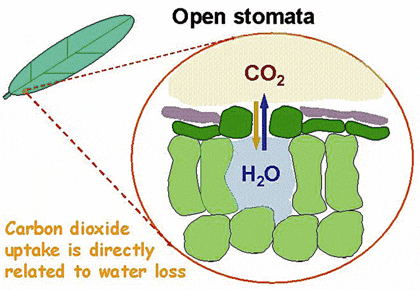
Plant growth is driven by trapping energy from the sun and using it to convert carbon dioxide into plant material through the process of photosynthesis. A plant acquires carbon dioxide by opening the stomata in the leaf (Figure 1). When the stomata are open, water is lost from the plant in a process known as transpiration. Loss of water is the natural tax that a plant must pay to get its basic requirements!
Based on this principle, Tanner and Sinclair showed in 1983 that daily plant growth is directly proportional to the amount of water a plant transpires per day and inversely proportional to the dryness of the atmosphere (i.e. vapour pressure deficit), thus: Daily plant growth = k*(T/V)
Where k is a plant constant known as the dry matter water ratio, T is transpiration in mm and V is the vapour pressure deficit.
This principle, coupled with a series of other algorithms describing crop growth processes is the basis of research done by the University of Pretoria (funded by the Water Research Commission) to establish the Soil Water Balance Model. This research has shown that by following the water balance in the soil-plant-atmosphere-continuum, a very good indication of the production potential of a soil-climate unit can be derived. Research done by the University of the Free State has also shown the value of including climate in assessments, i.e. the SWAMP model.
The value of these models are that, with the use of modern technology such as desktop computers and automated climate monitoring systems, it is possible to put numbers to intuitive observations. For example we know maize yields in the Bethlehem district are lower than other regions due to lower heat units while the Schweizer-Reneke district has ample heat units, but rainfall is a limitation.
|
|
Click on the image for a higher resolution. |
Figure 1: Diagrammatic representation of transpiration � open stomata in a leaf allow carbon dioxide intake, whilst losing water.
In this article:
New opportunities and challenges for soil cartographers
These models have opened new opportunities, as well as challenges, to soil cartographers when assessing lands. The opportunity is that by adopting these techniques soil cartographers can derive more accurate and scientifically based estimates on yield potential of soils. This is essential for effective precision farming and sound management of the natural resources.
The challenge is to numerically record the soil features that have a direct effect on the soil-profile-water-holding characteristics and link these features to the crop�s response to climatic factors such as:
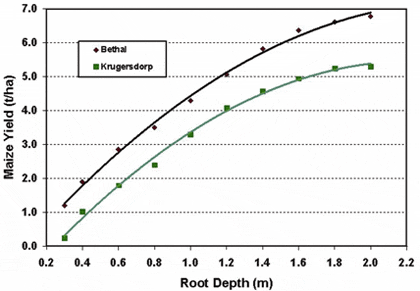
By doing this, it is possible to quantify the expected yield response for a soil characteristic, e.g. effective depth for different areas. This is shown in Figure 2.
 |
Click on the image for a higher resolution. |
Figure 2: Simulated yield potential increases with increase in root depth for two districts.
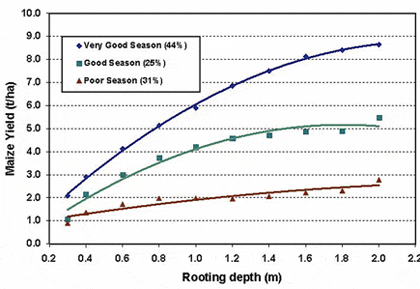
When incorporating weather data in the yield potential calculations, the effect of rainfall distribution is clearly identified. Generally it is possible to identify three types of seasons:
This effect is shown in Figure 3 for simulated yield responses done for soil and climate data from the Bethal district.
 |
Click on the image for a higher resolution. |
Figure 3: Simulated yield potential increases with increase in root depth for three season types in the Bethal district. Percentage values are the frequency of occurrence for a specific type of season.
Although this technique was initiated in South Africa and the first work done only in 2003, excellent agreement between predicted and actual results have been obtained where it has been possible to do comparisons with field trials or yield monitor data. Where differences have been identified, this has been as a result of either nutrient deficiencies or another overriding yield limiting factor.
If you require any further information about soil assessments please contact Dr Neil du Sautoy at Senwes Agricultural Services on 082 419 0949 or (018) 464-7391 or send an e-mail to [email protected].
At present Senwes Agricultural Services is implementing this approach to soil potential assessments and building up its database. We would therefore appreciate the co-operation of anybody who has yield monitor data that could be used.
 |
Click on the image for a higher resolution. |
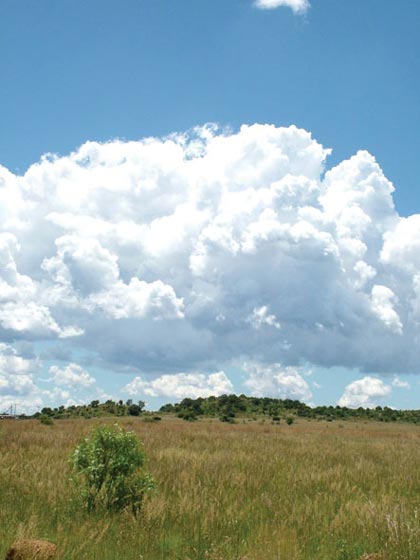
The effect of rainfall distribution has a great effect on yield potential calculations.